memory-repair-lab - the model never learns; the notes do

A memory-repair loop over a markdown agent wiki: failures are filed as typed notes, repairs cite the failure that motivated them, and generations are re-measured against a held-out split sealed before generation zero - with a placebo arm, a regression gate, and a Goodhart demonstration shipped on purpose.

✓ every measured number on this page regenerates in CI with zero API keys

The agentic graph

Each node a role, each edge an artifact you can open in an editor. The placebo arm runs with the failure-record edge cut.

MEMORY (wiki notes) --index--> EVALUATOR --misses--> FAILURE RECORDS FAILURE RECORDS --citations--> REPAIRER --candidate edits--> GATES GATES (regression replay + citation check) --accepted diffs--> MEMORY

One generation, replayed

These lines are quoted verbatim from the demo's streamed output - the same pipeline CI regenerates on every push.

Verbatim from python -m repairlab demo; condensed between beats.

The four arms

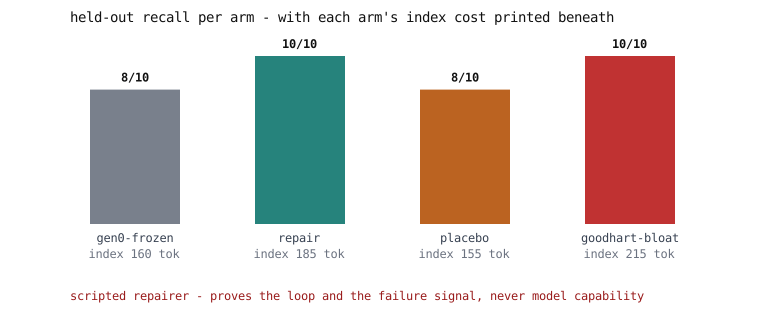
held-out recall per arm with index token cost beneath each bar

The disclaimer lives inside the SVG: “scripted repairer - proves the loop and the failure signal, never model capability”.

Held-out recall (pinned by tests): frozen gen-0 8/10 → repair arm 10/10; the blind placebo arm, same budget, stays at 8/10 - the failure signal, not the editing, does the work. The Goodhart bloat arm also reaches 10/10 but pays for it on the index, its price printed beside its gain.

What this does NOT show

The loop is proven; reflection is not

The repairer is a deterministic rule reading failure records and note bodies - never the held-out questions (a test enforces the wall). Gains are upper bounds on author-labeled fixtures; “recursive” in the strict sense - repair policies that are themselves notes under repair - is Loop 2, documented future work, not marketed until it exists in code. The weights never change; every gain is a diffable text artifact in git log -p.